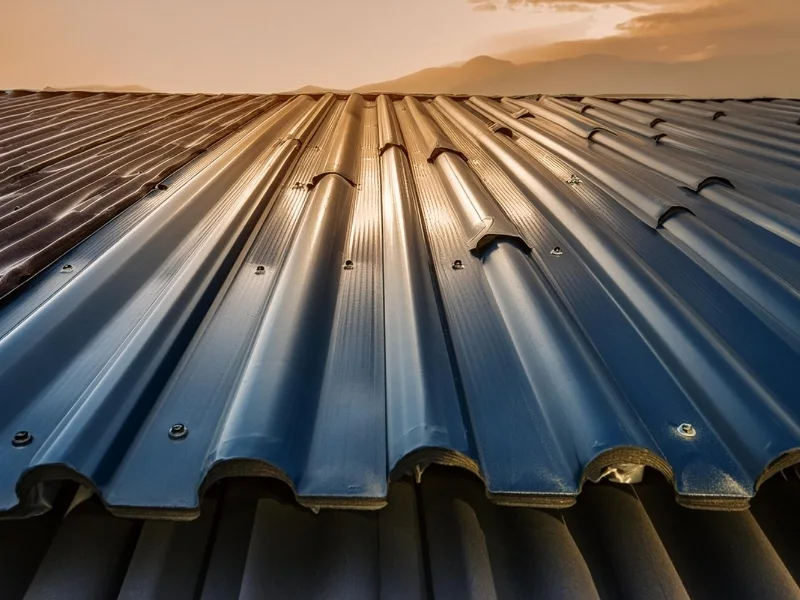
What Oil Canning Is
Understanding what oil canning is helps a Plymouth homeowner. Here is the explanation.
Slight Waviness in Flat Areas
Oil canning is the slight waviness, rippling, or distortion that can appear in the broad flat areas of metal roof panels, a visual characteristic of metal roofing. It shows in the flat sections. It is a gentle waviness. It appears on flat areas. It is a visual trait. It is characteristic of metal.
An Inherent Tendency of Flat Metal
Oil canning is an inherent tendency of flat metal surfaces to some degree, since broad flat areas of metal can show this rippling, more so than ribbed or contoured surfaces. It is inherent to flat metal. Broad flats are prone to it. It relates to the flat surface. It is a natural tendency. It is part of metal's behavior.
More Visible in Certain Conditions
Oil canning is more visible in certain lighting and viewing angles, since light across a flat surface can highlight slight waviness that is otherwise hard to see. Lighting affects its visibility. Angles matter. It can be subtle. Conditions highlight it. It varies with viewing.
A Visual Characteristic
Oil canning is fundamentally a visual characteristic of metal roofing, an appearance trait rather than a sign of damage. It is about appearance. It is a visual trait. It is characteristic of the material. It is not damage. It is cosmetic in nature.
What It Is, in Short
Oil canning is the slight waviness, rippling, or distortion that can appear in the broad flat areas of metal roof panels, an inherent tendency of flat metal surfaces that is more visible in certain lighting and viewing angles, fundamentally a visual characteristic of metal roofing.
It also helps Plymouth homeowners to understand both why oil canning happens and how a quality roof minimizes it, because this turns a potentially worrying topic into a manageable one with practical solutions. Oil canning typically results from a combination of factors rather than a single cause. It relates to stresses within the metal, which can arise during manufacturing, handling, or installation, and flat metal panels can develop slight waviness as they respond to these internal stresses. The nature of flat metal itself plays a role, since broad flat areas reveal distortion more than contoured ones. How the panels are handled and installed matters too, because careless handling or installation can introduce additional stresses that contribute to oil canning, while careful work avoids them. And the metal's response to temperature changes, its natural expansion and contraction, can play a part as well. The good news is that all of this can be minimized through several means. Panel design is one of the most effective, because features like striations, ribs, or texture built into the panels break up the broad flat areas and significantly reduce the visibility of any waviness. Careful handling of the panels and a quality installation that avoids introducing stresses both help, which is one more reason that choosing an experienced, quality contractor matters. And material considerations, such as the metal and its thickness, can influence oil canning as well, with a contractor able to advise on choices that help. So the practical guidance for a homeowner is to expect that some degree of oil canning can be normal, to view it realistically as a cosmetic characteristic, and, if it is a concern, to discuss panel options like striated or ribbed panels with their contractor, since a well-made, well-installed metal roof tends to show minimal oil canning.
One point worth making clear for Plymouth homeowners is what oil canning is and, importantly, how to think about it, because it is a term that comes up around metal roofing and can cause unnecessary worry if it is misunderstood. Oil canning refers to the slight waviness, rippling, or visual distortion that can appear in the broad flat areas of metal roof panels. It is, to some degree, an inherent tendency of flat metal surfaces, because broad flat areas of metal naturally reveal slight distortion more readily than ribbed or contoured surfaces do, and it tends to be more visible under certain lighting conditions and from certain viewing angles, since light raking across a flat surface can highlight gentle waviness that would otherwise be hard to notice. The most important thing for a homeowner to understand is that oil canning is fundamentally a visual or cosmetic characteristic of metal roofing, an appearance matter rather than a sign of damage, a defect, or a structural problem. The slight waviness does not affect the roof's strength or integrity, and it does not affect the roof's performance, the roof still sheds water and protects the home exactly as it should. So whether oil canning matters at all really comes down to a homeowner's appearance preferences, because some people notice it and find it bothersome while others do not notice or mind it, but in either case it is an aesthetic consideration rather than a functional one. Viewing oil canning realistically, as a normal visual characteristic of metal roofing rather than a flaw, helps a homeowner approach a metal roof with the right expectations, and the encouraging news is that there are well-established ways to minimize it.
It also helps Plymouth homeowners to understand both why oil canning happens and how a quality roof minimizes it, because this turns a potentially worrying topic into a manageable one with practical solutions. Oil canning typically results from a combination of factors rather than a single cause. It relates to stresses within the metal, which can arise during manufacturing, handling, or installation, and flat metal panels can develop slight waviness as they respond to these internal stresses. The nature of flat metal itself plays a role, since broad flat areas reveal distortion more than contoured ones. How the panels are handled and installed matters too, because careless handling or installation can introduce additional stresses that contribute to oil canning, while careful work avoids them. And the metal's response to temperature changes, its natural expansion and contraction, can play a part as well. The good news is that all of this can be minimized through several means. Panel design is one of the most effective, because features like striations, ribs, or texture built into the panels break up the broad flat areas and significantly reduce the visibility of any waviness. Careful handling of the panels and a quality installation that avoids introducing stresses both help, which is one more reason that choosing an experienced, quality contractor matters. And material considerations, such as the metal and its thickness, can influence oil canning as well, with a contractor able to advise on choices that help. So the practical guidance for a homeowner is to expect that some degree of oil canning can be normal, to view it realistically as a cosmetic characteristic, and, if it is a concern, to discuss panel options like striated or ribbed panels with their contractor, since a well-made, well-installed metal roof tends to show minimal oil canning.
Learn About Metal Roofing With Us
Plymouth Metal Roofing installs quality metal roofing across Plymouth and Marshall County and is happy to explain its characteristics. Call (765) 676-3491 for a free consultation on a quality metal roof for your home.